- Home
- Middle East
- Israel Prepares to Seek New Security Pact With U.S., Report Says
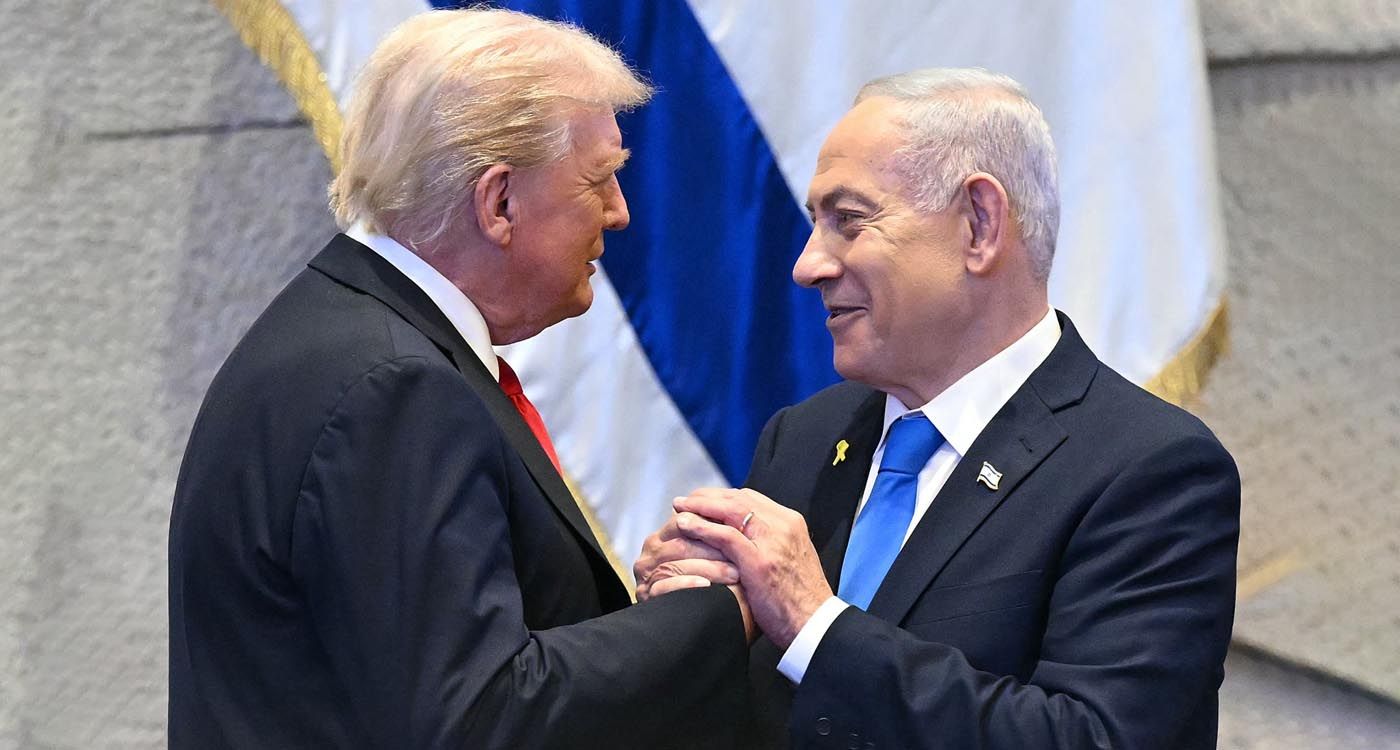
U.S. President Donald Trump holds hands and talks with Israeli Prime Minister Benjamin Netanyahu at the Israeli Parliament, the Knesset, in Jerusalem on October 13, 2025. ©Saul Loeb/POOL/AFP
Israel is preparing to enter talks with the administration of President Donald Trump on a new decade-long security agreement, signaling a strategic shift in how it seeks to secure American support, one that prioritizes joint military projects over direct financial aid, according to a report by the Financial Times on Tuesday.
The discussions, expected to take place in the coming weeks, would focus on extending U.S. military backing beyond the current framework, even as Israeli leaders acknowledge that long-term American financial assistance may gradually decline.
The report cites Gil Pinhas, a former financial adviser to Israel’s defense ministry, who said Jerusalem is increasingly focused on deepening industrial and technological cooperation with Washington rather than relying on annual cash-based assistance.
“Partnership is more important than funding alone,” Pinhas told the Financial Times. “There are many things that are equivalent to money. This needs to be viewed more broadly.”
From Aid to Partnership
Under the existing 10-year memorandum of understanding (MoU) signed in 2016, the United States committed $38 billion in military assistance to Israel through September 2028. That package includes $33 billion in grants for U.S. weapons purchases and $5 billion earmarked for missile defense programs.
Pinhas told the Financial Times that the annual direct military financing, estimated at around $3.3 billion, is one of the provisions that could be gradually scaled back under a future agreement, as Israel looks to redefine the nature of its defense relationship with Washington.
Instead, Israeli officials are expected to push for expanded cooperation on joint weapons development, advanced air and missile defense systems, and shared military technologies, areas viewed as offering longer-term strategic value than cash transfers alone.
Netanyahu Signals Shift in Strategy
The report comes weeks after Benjamin Netanyahu publicly expressed hope that Israel could reduce its reliance on U.S. military aid over the next decade, framing the goal as part of a broader effort to strengthen Israel’s defense independence while preserving its strategic alliance with Washington.
Any new agreement would likely reflect Israel’s assessment that future U.S. administrations may face growing domestic pressure to limit overseas military spending, even toward close allies.
A Changing U.S.-Israel Defense Relationship
The push for a new security framework comes at a time of heightened regional instability, with Israel engaged in prolonged military operations and the United States recalibrating its global defense priorities.
Since the 2016 MoU was signed, Israel has significantly expanded its domestic defense industry, increased arms exports, and deepened cooperation with U.S. firms on missile defense systems such as Iron Dome, David’s Sling, and Arrow. Israeli officials now argue that joint production, technology sharing, and guaranteed access to U.S. systems may offer more durable security benefits than fixed aid levels.
At the same time, Washington’s focus on competition with China and the strain of multiple global crises have sharpened debates in the U.S. over foreign military assistance. Against that backdrop, Israel’s move appears aimed at locking in strategic cooperation while adapting to a future in which American support may come less in the form of direct funding and more through integrated defense partnerships.
Read more

Comments