- Home
- Middle East
- Hamas Signals Readiness to Disarm
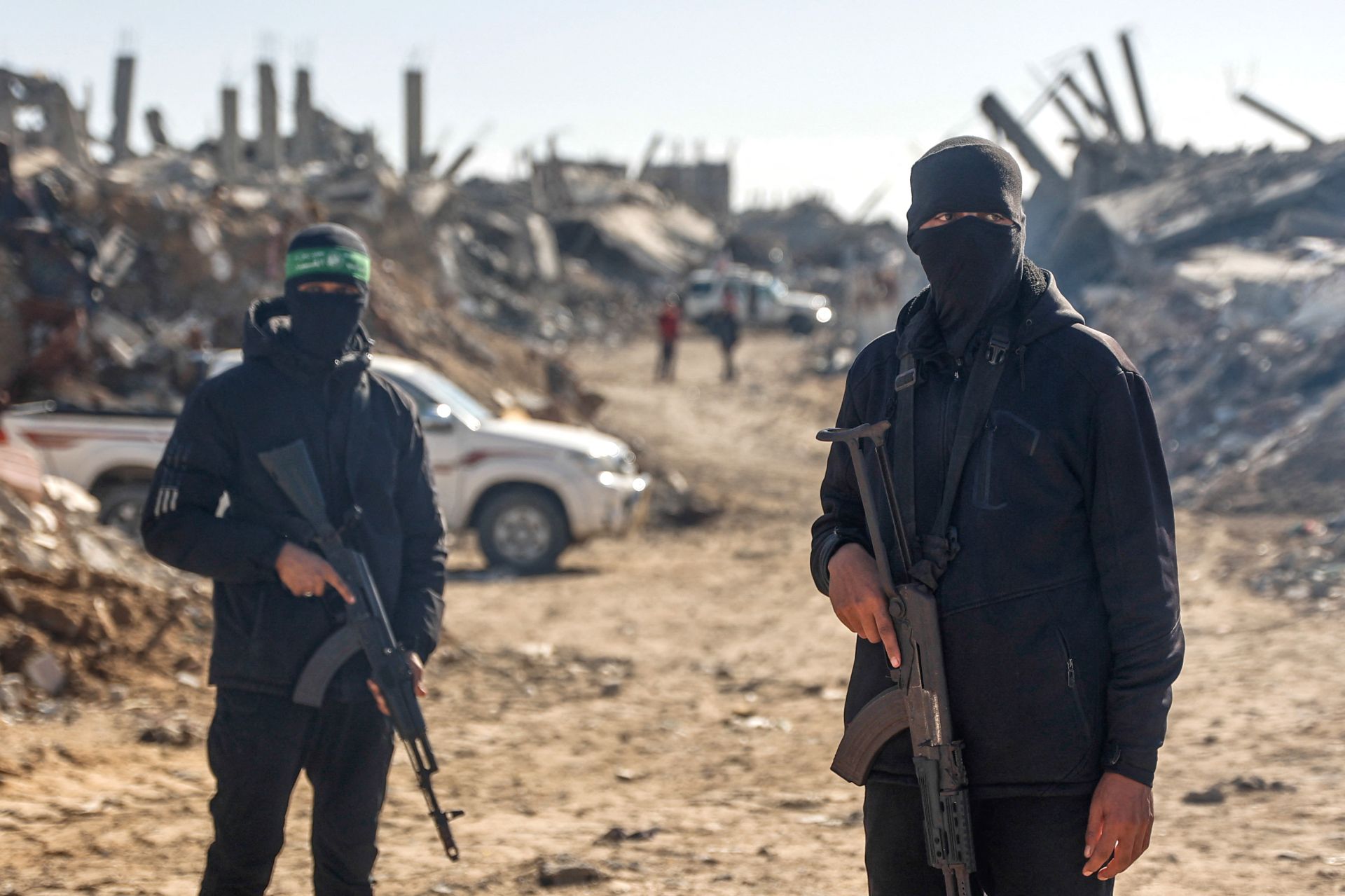
Palestinian Hamas militants secure the area as Egyptian workers accompanied by members of the International Committee of the Red Cross (ICRC) search for the last two remaining bodies of hostages -an Israeli soldier and a Thai national- from under the rubble of the Jabalia refugee camp, in the northern of Gaza Strip on December 1, 2025. ©OMAR AL-QATTAA / AFP
Hamas has reportedly agreed to surrender its weapons and hand over detailed maps of its tunnel network in Gaza as part of a U.S.-mediated arrangement, according to a Palestinian source cited by Sky News Arabia, a development that would mark a major turning point in the aftermath of the war.
The report surfaced after President Donald Trump issued one of his starkest warnings to the Palestinian group, saying Hamas would be “blown away” if it failed to disarm during the next phase of the Gaza ceasefire, underscoring Washington’s intent to enforce a demilitarized postwar order in the enclave.
A Deal Centered on Disarmament
According to the source, the reported understanding would see Hamas relinquish its weapons and provide tunnel schematics through an undisclosed mechanism in exchange for being allowed to continue operating as a political movement in Gaza, stripped of its military wing.
Under the same framework, Hamas leaders, both political and military, would be permitted to leave Gaza safely if they choose, with U.S. guarantees that Israel would not target them nor senior figures already based abroad. Washington is also said to be exploring the integration of some Hamas-affiliated police officers and former civil officials into Gaza’s future administration, subject to joint Israeli-American security screening.
If implemented, the arrangement would amount to the most far-reaching effort yet to dismantle Hamas’ military infrastructure while avoiding a complete political vacuum in Gaza.
Israel Holds Firm, PA Backs the Framework
Israeli officials have expressed significant reservations, particularly over any provision that would allow Hamas to retain a political role after the war. Prime Minister Benjamin Netanyahu has repeatedly said Israel remains committed to its core objectives in the second phase of the ceasefire: the disarmament of Hamas and the full demilitarization of Gaza.
At the same time, the Palestinian Authority has reportedly voiced conditional support for the proposal, viewing it as a means to consolidate the end of the fighting, stabilize governance, and accelerate reconstruction in the devastated territory.
The divergence highlights the fragile political balance shaping Gaza’s postwar negotiations, with Israel prioritizing security guarantees and Washington pushing for a workable transitional arrangement.
Trump Raises the Stakes in Davos
Speaking at the World Economic Forum in Davos, the U.S. President framed Hamas’ disarmament as non-negotiable, warning that failure to comply would lead to decisive consequences.
“They were born with a weapon in their hand,” he said. “But if they don’t do it, they’ll be blown away.”
The comments came as President Trump’s Board of Peace, a U.S.-led body designed to oversee the implementation of the Gaza ceasefire and postwar administration, moved closer to formal launch, signaling Washington’s intent to take a direct role in shaping Gaza’s political and security future.
U.S. officials have repeatedly stressed that the second phase of the ceasefire hinges on Hamas surrendering its arms, dismantling its tunnel network, and relinquishing control over security in the enclave.
Gaza at a Defining Moment
After more than two years of war, Gaza’s military, political, and social landscape has been profoundly altered. The reported willingness of Hamas to disarm, under intense U.S. pressure and Israeli scrutiny, places the territory at a critical crossroads.
Whether Hamas can be transformed into a purely political actor, or whether the failure of disarmament talks triggers a renewed cycle of violence, will shape not only Gaza’s future but also the broader balance of power across the Middle East in the months ahead.
Read more

Comments