- Home
- Middle East
- Syrian Government, SDF Announce Four-Day Truce as SDF Pulls Guards from Al-Hol
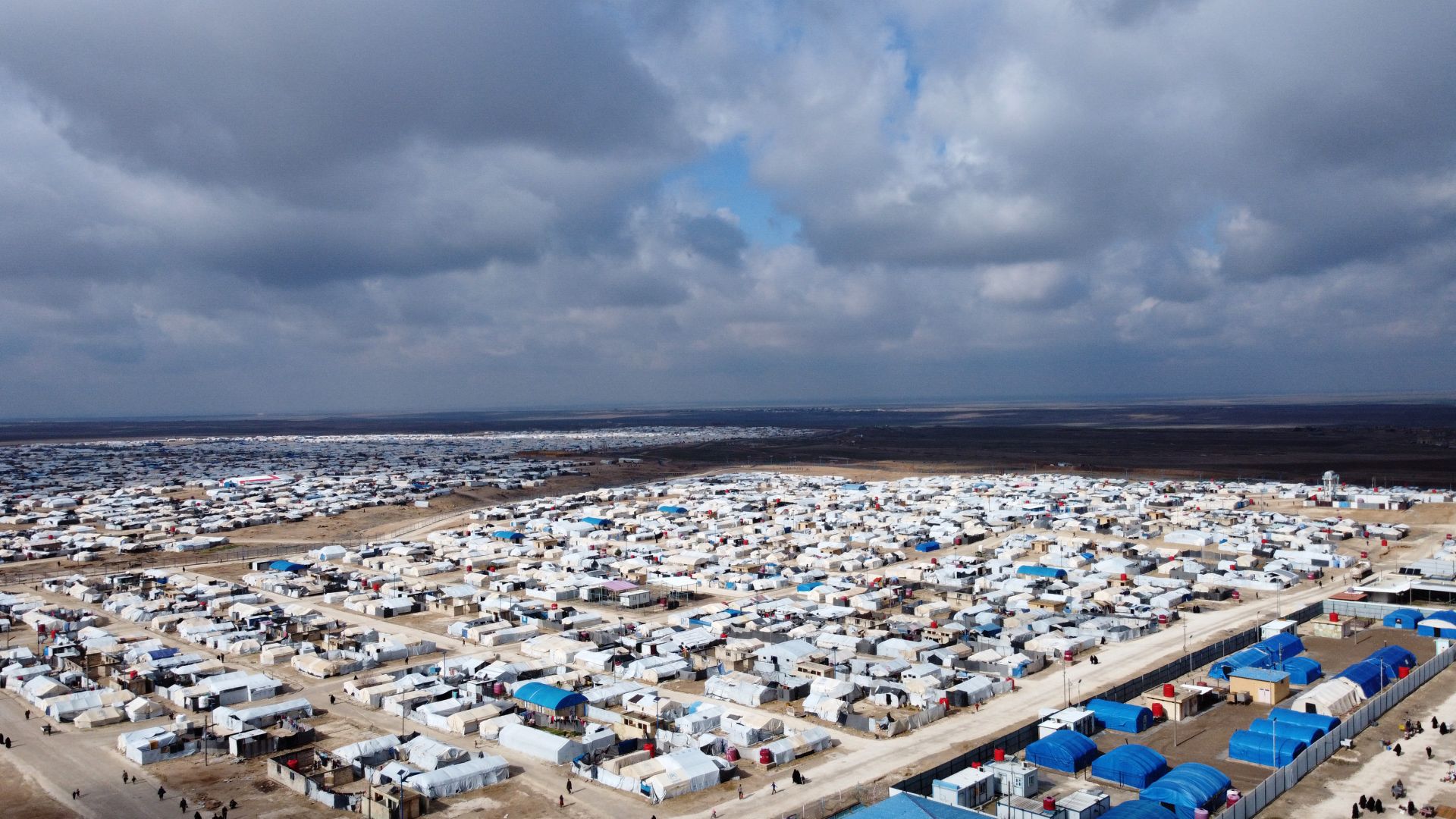
Cette image aérienne, prise le 27 janvier 2024, montre une vue du camp d'Al-Hol dans le gouvernorat syrien d'Al-Hasakah, au nord-est du pays. ©Delil Souleiman / AFP
The Syrian government and the Kurdish-led Syrian Democratic Forces announced a four-day truce on Tuesday while SDF guards monitoring the Al-Hol camp retreated from their posts.
Just before the truce, SDF personnel guarding the Al-Hol camp in northeast Syria withdrew from their posts to be redeployed to other cities in the region.
Last week, negotiations between the Syrian government and the SDF on how to integrate forces broke down into fighting east of Aleppo. The exchange of fire killed at least 23, according to the Syrian Health Ministry, with thousands more fleeing the area.
On Friday, Syrian president Ahmed al-Sharaa issued a decree granting Syrian Kurds citizenship rights and offering official status to the Kurdish language.
A recent ceasefire collapsed on Monday, escalating fighting ahead of Tuesday’s truce.
A Precarious Al-Hol
According to an SDF press release: "Our forces were compelled to withdraw from Al-Hol camp and redeploy in the vicinity of cities in northern Syria that are facing increasing risks and threat."
The Syrian government sent troops towards the nearby city of Hasakeh following its seizure of Raqqa and Deir Ezzor to secure the camp. The ministry of defense will assume responsibility over Al-Hol and the Islamic State affiliates detained inside.
Once holding over 70,000 people in its 2019 peak following the defeat of the Islamic State, Al-Hol still hosts over 24,000 people in its camps and prisons, many of whom are alleged to have connections to the organization.
The Syrian government accused the SDF of utilizing Islamic State prisoners as bargaining chips, as the SDF condemned the international community for its indifference towards containing Islamic State contingents.
At the moment, it is unknown whether any inmates affiliated with the Islamic State have escaped.
A Quid-Pro-Quo?
The U.S. was notably quiet as its Kurdish ally suffered a defeat against the al-Sharaa-led Syrian government, reportedly not responding to any requests for military help, according to SDF sources.
Furthermore, in a post on X, U.S. Syria Envoy Tom Barrack has characterized the SDF as no longer necessary for U.S. counterterrorism interests in Syria, with a capable and cooperative government in Damascus.
The U.S. supported the SDF’s rise to power in the mid-2010s in the absence of a central state authority to combat the Islamic State, providing over $1 billion in support to the organization over the last decade.
The al-Sharaa-led Syrian government has proven itself a reliable antiterrorism partner through relaying high quality intelligence on the Islamic State and having the capacity to act on the threats that may arise within Syrian territory. In November 2025, Syria joined the U.S.-led coalition against ISIS.
This reflects a concrete U.S. policy position taken in support of the Syrian government, which suggests both its trust in the regime and the prospect that concessions would be made.
Northeast Syria contains key natural resources such as oil, natural gas, and phosphate, which is in-demand for the Syrian state and the international community alike. Likewise, solidifying Syrian government control over the fertile Euphrates valley grants more productive arable land and reliable access to water resources to Damascus.
Negotiation over how to allocate the benefits of these resources was a sticking point in talks between the Syrian government and the SDF over integration. The value of these assets would not be lost upon the U.S.
At the same time, the Syrian government’s escalations against the SDF coincided with the U.S.-mediated encounter between Syrian and Israeli officials in Paris earlier this month. With renewed discourse surrounding the potential for a security deal to be reached between Syria and Israel, any implicit U.S. support for consolidation of SDF-held territory on al-Sharaa’s terms may be an incentive to sign onto such an agreement.
As the U.S. steps away from its historic Kurdish partner in northeast Syria and as rhetoric in Israel shifts towards the possibility of stepping back from its Druze allies in southern Syria, a paradigm of international support for autonomous minority groups in Syria may be replaced by further incorporation of Syria into a regional network of moderate U.S. allies with strengthened security arrangements with Israel
Read more

Comments