- Home
- Middle East
- Festive Lights, Security Tight for Christmas in Damascus
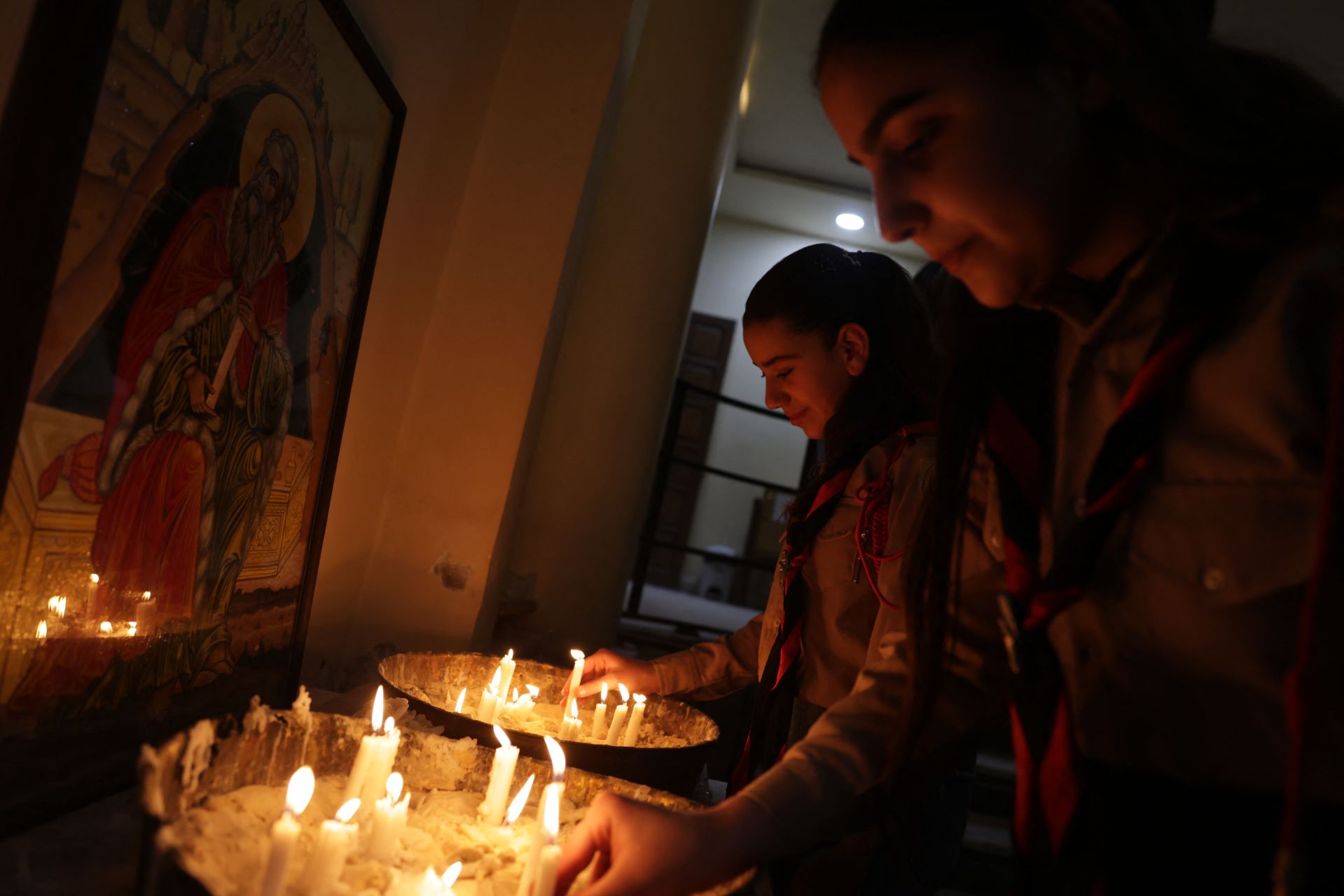
Hanaa Masoud lights candles inside a church after of an explosion that killed her husband and family, this follows increased security measures at Damascus Christian sites and areas ahead of Christmas on December 23, 2025. ©BAKR ALKASEM/AFP
Christmas lights illuminate Damascus's Old City while government forces patrol its shadows as security fears haunt Syria's Christian community.
They recall the shooting and suicide attack in June at the Saint Elias church in the Syrian capital that killed 25 people and wounded dozens more.
"People are going home early, and are afraid," said Tala Shamoun, 26, a university student who was visiting a Christmas market with family and friends.
Damascus has seen crime including robberies and kidnappings, she said, but the attack on the church "was the biggest tragedy", she told AFP.
Syria's authorities blamed the Islamic State jihadist group, while a little-known Sunni Muslim extremist group claimed responsibility.
The Islamists that ousted ruler Bashar al-Assad last year have reaffirmed their commitment to coexistence among all of Syria's religious groups, vowing to involve everyone in the transition.
But earlier this year, the country's Alawite heartland saw sectarian massacres, while Druze-majority areas in the south were hit by major clashes.
'Security plan'
Interior ministry forces searched some pedestrians or stopped people on motorbikes in the Old City.
At one of the district's main entrances, an armed member of the government security forces was holding a walkie-talkie and a map of where his personnel were deployed.
"We've put a security plan in place that includes several districts and areas in the capital, in order to ensure the safety of all citizens," he said on condition of anonymity.
"It is the state's duty to protect all its people, Christian and Muslim, and today we are doing our duty to protect the churches and secure people's celebrations," he added.
Ousted ruler Assad, himself an Alawite, had long presented himself as a protector of minorities, who were the target of attacks during Syria's war, some of which were claimed by jihadists.
Syria's Christian community is believed to have shrunk from one million in 2011, when the war began, to around 300,000 today, with many seeking refuge abroad.
In the Old City, home to a small but vibrant Christian community and several important churches, red baubles hang from some trees, shopkeepers have put up Christmas decorations and street vendors peddle warm chestnuts.
So-called neighbourhood committees are also providing additional security, with dozens of local Christians protecting churches in coordination with government forces.
'Syria deserves joy'
Fuad Farhat, 55, from the area's Bab Touma district, was supervising the deployment of several unarmed, black-clad Christian men with walkie-talkies in front of the churches.
Many people fear that Christmas crowds could heighten security risks, but with the additional measures "they feel safer and are more comfortable going out", he said.
"We have been taking steps to protect those celebrating in the Christian neighbourhoods" to avoid any problems, in coordination with the security forces, he said.
University student Loris Aasaf, 20, was soaking up the Christmas atmosphere with her friends.
"Syria deserves joy and for us to be happy, and to hope for a new future," she said.
"All sects used to celebrate with us, and we hope to see this in the coming years, in order to rebuild Syria," she added.
Near the Saint Elias church which saw June's deadly attack, government security forces cordoned off entry and exit areas with metal barriers, while heavily armed personnel were searching anyone entering.
Church-goers lit up a tree decorated with stars bearing the image of those killed in June.
"Christmas this year is exceptional because of the pain and sorrow we went through," said housewife Abeer Hanna, 44.
"The security measures are necessary because we are still afraid," she said.
Nearby, Hanaa Masoud lit a candle for her husband Boutros Bashara and other relatives who were among those killed in the attack.
"If we go to church and get blown up, where can we find safety?" she said, choking back tears.
Maher al-Mounes/AFP
Read more

Comments