- 19
- Dec.
- 2025
Morocco, Kings of Arabia: a lob from outer space, VAR drama, and a hero out of nowhere
Read : 4 minute(s) A A A
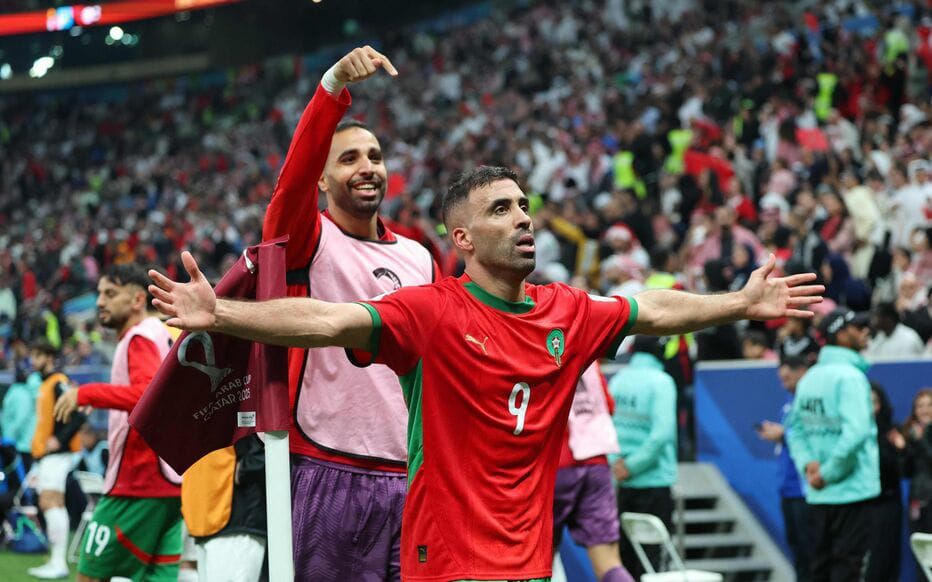
At Lusail, under rain lashing Doha on National Day, the Atlas Lions claimed the Arab Cup after a breathtaking final against Jordan (3–2 a.e.t.). A wonder strike from over 50 meters, an opponent who never gave up, and Hamdallah in savior mode: three days before the opening of “their” Africa Cup of Nations at home, Morocco have already lit the fuse.
There are nights when a stadium feels like a factory for storylines. Lusail — 84,517 spectators wrapped in improvised ponchos to fight off the downpour — delivered exactly that: a match that sprinted, flipped, twisted, and ultimately crowned the team that refused to fall. On Thursday, Tarik Sektioui’s Morocco lifted their second Arab Cup, thirteen years after 2012, following a suffocating tug-of-war against a Jordanian side determined to play spoiler until the very last breath.
A lob from another world, and Lusail freezes
The match barely had time to introduce itself — it exploded. In the 4th minute, Oussama Tannane spotted Jordanian goalkeeper Yazeed Abulaila slightly off his line… and dared the unthinkable. One audacious strike, a massive lob from over 50 meters (some would swear even more), and Lusail fell into stunned silence. Jordan were hit once, then again: on the pitch, Morocco took control — technically clean, superior in possession — with the sense they could double the lead before halftime, yet unable to seal it. The picture was beautiful, but incomplete: finishing, for now, was missing.
Jordan bite back
And in a final, inefficiency always comes at a price. After the break, Jamal Sellami’s Jordan emerged transformed: sharper, more direct, driven by a growing wave of belief with every forward run. Ali Olwan leveled the score with a header (47th/48th), and the match shifted into another dimension — one of nervous duels, whistles, and raw courage.
Then came the moment when Jordan thought they had touched the sky. Olwan again, converting a penalty (65th/68th) to complete his brace and turn the final on its head. Lusail became a pressure cooker: tension, noise, chaos — everything was there. The Nashama had the lead, the momentum, and even a match ball late in stoppage time — an effort miraculously saved by the Moroccan last line of defense, as if fate had decided to leave a blank page for what was still to come.
VAR, extra time, and the man who emerged
Backed into a corner, Morocco found what great teams find on wild nights: one last bullet. Abderrazak Hamdallah, introduced from the bench, equalized in the 88th minute, a goal confirmed after a VAR review. Suddenly, the final changed ownership: extra time, mano a mano, the kind of football where legs burn but minds refuse to surrender.
Jordan thought they had struck immediately — a goal was even scored at the very start of extra time, only to be ruled out for handball. One second that takes you from ecstasy to emptiness. And on nights like this, emptiness swallows everything.
Hamdallah then donned the full hero’s cape: opportunistic, clinical, decisive. In the 100th minute, he completed his brace and delivered the goal that sealed the cup. The Moroccan end exploded in euphoria; Jordan pushed again, but the thread had snapped.
A title, a signal, and AFCON already on the horizon
This Morocco side had not even unleashed all its stars: a rotated squad, a “second unit,” yet a clear trajectory, built on defensive solidity that had conceded very little before the final. Opposite them stood the tournament’s most potent attack, a red-hot Olwan, and a script that could have flipped a hundred times. Yet it was Morocco who walked away with the trophy, succeeding Algeria on the honors list of a FIFA competition featuring 16 teams from the Arab world.
And perhaps that is the loudest message of all: three days before the opening of the Africa Cup of Nations in Morocco (December 21–January 18), with a home opener against Comoros, the Atlas Lions have not only won a trophy. They have passed a nerve test, survived a storm, and conquered a final that forges a team.
AFCON hasn’t even begun — and Morocco have already found their first roar of victory. One that says: “We know how to suffer. And we know how to finish.”
Comments