- 12
- Dec.
- 2025
Storms in Lebanon: Why We Name Them, Why We Fear Them, Why We Wait for Them
Read : 7 minute(s) A A A
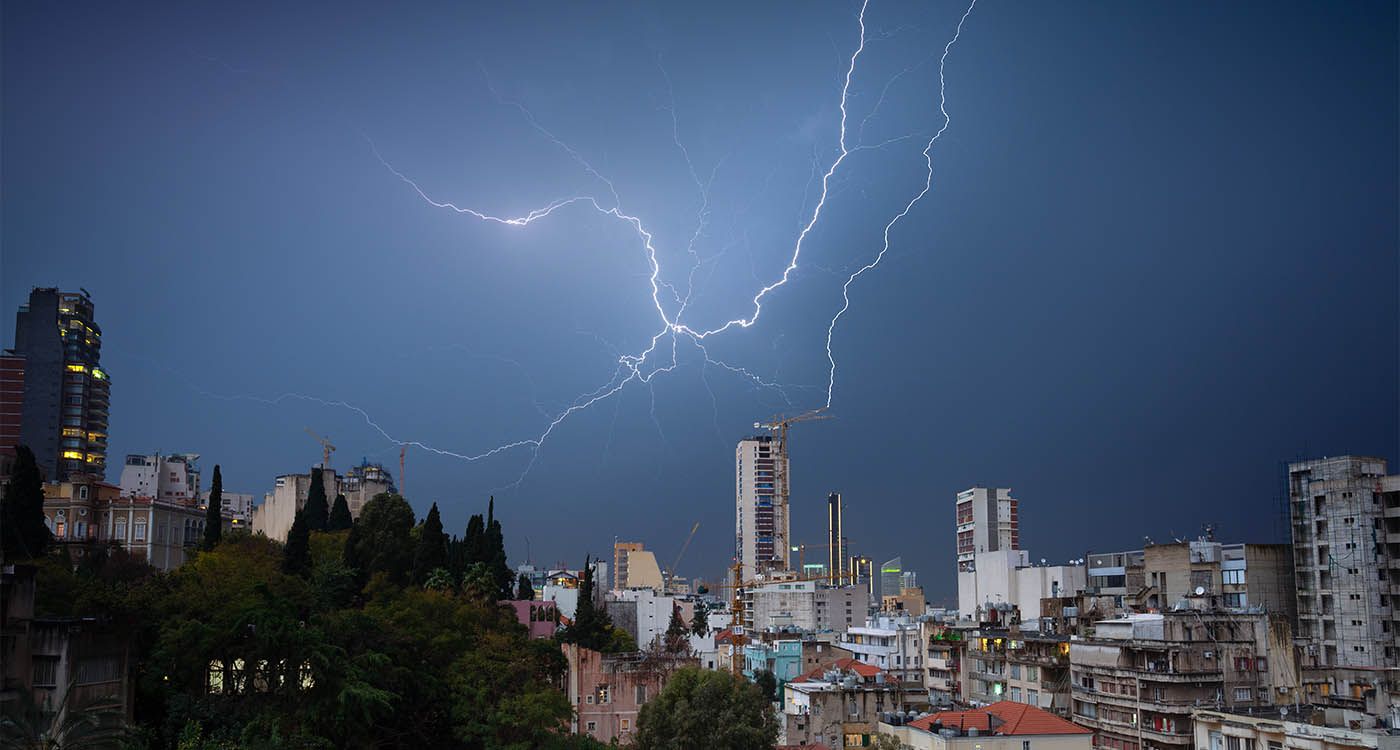
Armed with its anorak and sheltered under an umbrella, This is Beirut went to see what our storms really hide. In a country where we have four seasons and theoretically abundant water resources, each storm awakens the same refrain: roads turned into rivers, chaos on social networks, questions about water management… and curiosity about these storms which for a few years now have been given first names.
Adam, Farah, Norma, Zeina, Yohan, Oscar… In Lebanon, winter storms have taken on the appearance of characters. They pop up on weather maps, scroll across TV tickers and flood Instagram stories, as if winter too had its own cast. Yet behind the folklore of first names and the debates about “one storm too many” lies a much more serious reality: these windy and rainy episodes play a key role in our water reserves, for our health and in the lives of farmers. And for a few years now, their baptism has obeyed very precise criteria, defined by the meteorological service of Beirut international airport. Marc Wehaïbé, director of the Meteorology Department at Beirut airport, explains it exclusively to This is Beirut: “Giving a name is not a media gimmick. It is a tool to better inform the public when an episode really goes out of the ordinary.”
A country rich in water… but poor in storage
Lebanon is not a desert. It is even one of the few countries in the region to benefit, on paper, from substantial fresh water resources. Winter rain, snow on the mountains, natural springs: nature has been generous. But with every rainy episode the scene repeats itself: potholed roads turned into brown torrents, half-submerged cars, huge traffic jams, viral videos of streets turned into rivers. And a few months later, in the middle of summer, the same neighborhoods struggle to fill their tanks and cope with cuts from the water company. The question that then comes back, in cafés as well as on social networks, is: where does all this water go? The answer has less to do with the weather than with management. Low storage capacity, dams that are insufficient or poorly maintained, leaky distribution networks, chaotic urbanization that prevents infiltration into groundwater: the rain falls, but it is neither captured nor used as it should be. For water specialists, winter storms nevertheless represent a windfall. When they stretch over several days, with varying intensities, they recharge aquifers, feed springs, fill natural reservoirs. On condition that they do not turn into brutal deluges that wash away soils, erode mountain slopes and disappear too quickly into the sea.
When rain cleans the air… and makes children cough
For health, the arrival of a major storm tells a two-sided story. On the one hand, rain acts like a gigantic atmospheric shower. As they fall, the drops carry with them dust, fine particles, pollen, mold spores. The air becomes cooler, more “breathable”. People who are allergic to pollen or household dust often feel a respite: fewer sneezing fits, fewer itchy eyes, less breathing discomfort. On the other hand, winter remains the season of viruses. Cold, humidity, poorly insulated homes where people huddle together, windows closed in schools and offices: all the conditions are in place for respiratory infections to circulate faster. Flu, bronchiolitis, rhinopharyngitis, Covid and consorts take advantage of these periods when we live more indoors. Doctors note it every year: large rainy spells sometimes coincide with peaks of crowding in waiting rooms. Not because of the rain itself, but because it comes with a sudden cooling of the air, poorly managed temperature changes and increased promiscuity. In short, the storm can do the bronchi good by cleaning the atmosphere, while filling pediatric and general practitioners’ surgeries.
The farmers, for their part, wait for “the right rain”
On the heights of the Bekaa, in the orchards of the Metn or on the hills of the South, farmers scan the sky with a different reading grid. For them, rain is neither a simple backdrop nor a topic of conversation: it is the condition for the survival of their crops. They wait for water “at the right time”. Too early in the season, heavy rainfall can disrupt certain blossomings or encourage the development of fungal diseases. Too late, it risks causing damage at the critical moment of harvest, making fruit split or rotting crops that are ready to be picked. To this is added the dread of hailstones, which in a few minutes can wipe out months of work on vines, citrus groves or fruit trees. The ideal scenario? A succession of moderate depressions, well distributed between autumn and spring, giving soils time to absorb the water, reservoirs time to fill up and crops time to adapt. Violent storms, on the other hand, are feared: they flood, tear up, crush. But even these extreme episodes, when they remain rare, help to recharge a water cycle poorly exploited by the public authorities.
Why give storms first names?
At international level, it was first tropical cyclones that were baptized. Meteorologists realized that a short, easily memorable first name was much more effective than a string of numbers or coordinates for warning the general public. Gradually, official lists were drawn up under the aegis of scientific bodies. “The current lists,” explains Marc Wehaïbé, “mix male and female first names, chosen well before the season. We follow the alphabetical order, and we alternate genders for the sake of balance. The idea is to avoid disasters being associated only with women’s names, as was the case in the past.” Historically, he recalls, it was sailors who first gave names to hurricanes, often reusing those of their loved ones left on shore, out of nostalgia. Hence the persistent impression, still today, that storms “mostly carry female first names”.
The Lebanese case: very precise criteria, a list that starts with Z
And Lebanon in all this? “For a long time, here, we did not give names to storms,” says Marc Wehaïbé. “Then, little by little, institutions and even private individuals started doing it, each in their own way. We ended up with the same depression carrying several names depending on the media. For the population, it was incomprehensible.” To bring some order to this cacophony, the Meteorology Department of Beirut airport decided to establish its own list of first names and clear criteria. “We do not baptize winter, nor every disturbance,” insists Wehaïbé. “A storm only receives a name if two conditions are met: gusts of wind that exceed 90 km/h and snow that comes down below 1,000 meters in altitude. In the Lebanese context, these are warning signals: trees likely to be uprooted, advertising panels that can fly away, traffic paralyzed, mountain roads cut off, schools closed.” Another particularity: the Lebanese list starts with the letter Z. “The first storm to which we officially gave a first name was called Zeina,” he explains. “We therefore decided to go back up the alphabet, without really making an alternation between a male first name and a female first name.” According to him, only the meteorological service of the airport has the legitimacy to assign these names. “We do not do it for show or for social networks, but to standardize warning messages. When a named storm is announced, the public immediately understands that this is not a simple rainy spell.”
Between fear, irony and fascination
On forums and in article comments, reactions remain mixed. Some see these first names as a gimmick or a “joke”, recalling that winter has always existed in Lebanon and that our parents did not stop living for a few days of wind and rain. Others point out that humanity has always personified the elements: from the winds of Greek mythology – Zephyr, Boreas, Eurus, Notus – to the storm gods of ancient Egypt or Phoenicia. In reality, our relationship with storms says a lot about our times. We fear them for their immediate effects – flooded roads, power cuts, material damage – but we also wait for them for what they bring: water we lack in summer, an atmosphere washed of its dust, a winter that still looks like a winter. Deep down, the real question may not be whether the next storm will be called Zeina, Norma or otherwise. The real storm to fear, specialists warn, is not the one that falls on our roofs this week: it is the one in the years when the rain will come less, when the snow will retreat, when the country will continue to waste the few resources it has. Until then, every time the sky clouds over and the weather forecast announces a named storm, Lebanon will grumble about traffic jams, tremble for its balconies… and, despite everything, cast a grateful eye at those clouds which, once again, come to fill reserves we do not always know how to keep.
Comments