- 07
- Dec.
- 2025


As Lebanon enters a historic shift toward peace, Pope Leon XIV’s visit has brought back to the forefront a word laden with promises and tensions: hope. At once a spiritual virtue, a theological concept and a political tool often subject to instrumentalization, the term reveals the depth of a country still struggling to rebuild itself. What does hope look like when a nation finds its future hanging by a thread?
“Young people of Lebanon, grow strong like the cedars and let the world blossom with hope!”
With these words, Pope Leon XIV concluded his address to the 15,000 Lebanese youths gathered around him on December 1 at the patriarchal siege in Bkerke.
“Hope”, a word charged with meaning and symbolism, invites us to revisit both its spiritual dimension, deeply rooted in Christian tradition, and its political use, sometimes mobilizing, sometimes opportunistic.
In a country long torn by crises, the term now carries a particular resonance. What does it mean to hope when the very future of a nation is shifting toward an assumed choice of peace?
Between Hope and Hopefulness
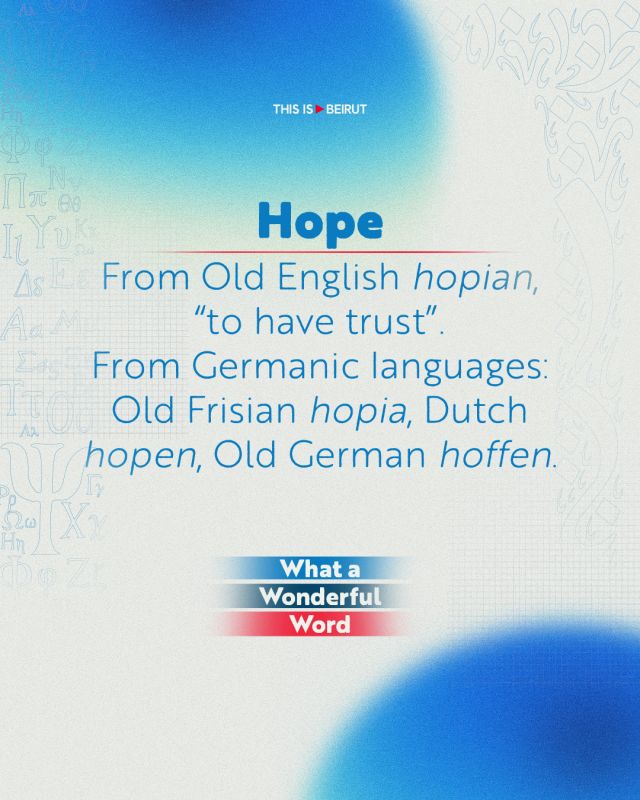
The English word hope dates back to Old English (hopian), used before the 12th century to mean “to trust,” “to have confidence,” or “to place one’s expectations in divine mercy or salvation.” Its origin is uncertain, but its usage spread across North Sea Germanic languages (Old Frisian hopia, Middle Low German hopen, Middle Dutch hopen).
By the early 13th century, the verb had expanded to mean “to wish for” or “to desire,” marking the beginning of its broader emotional and psychological use. The noun hope appears in roughly the same period and is attested throughout the Old English corpus.
Over the centuries, English maintained a single term – hope – to cover what French distinguishes as espoir (a circumstantial, worldly expectation) and espérance (a deeper, more resilient form of hopefulness rooted in spiritual trust). English relies instead on context, theology or syntax to differentiate simple optimism from theological virtue.
One expression captures this nuance particularly well: “to hope against hope.” First recorded in the early 1600s, it reflects the paradox of maintaining hope despite the absence of any rational justification, echoing St. Paul’s line in Romans 4:18, “Who against hope believed in hope.”
Religious Hope: A Moral Compass for a Country in Transition
In Christian theology, hope is not optimism. It does not depend on events or circumstances. It surpasses reality, transcends it. It feeds neither on political cycles nor on favorable conditions, but springs from an inner movement, a confidence that survives trials. Theologians describe it as the virtue that allows one to believe in the good even when everything seems lost.
This is the framework that gives full meaning to Pope Leon XIV’s appeal to Lebanon’s youth. He was not simply asking them to wish for a better Lebanon, but to carry a form of hopefulness rooted in a collective project: that of a country choosing peace over confrontation, dialogue over paralysis.
This understanding of hopefulness aligns with a long papal tradition addressing wounded peoples – from John Paul II in Poland to Francis in Iraq. In these contexts, hope is presented as an active, almost revolutionary force: a lever of transformation that is both spiritual and political.
In Lebanon, this message resonates strongly. The Pope’s visit effectively consecrated an emerging orientation: a nation seeking to escape cycles of violence, restore its sovereignty, and reconnect with its neighbors.
Hope as a Political Tool: Collective Motor or Rhetoric tool?
In Lebanese political discourse, “hope” occupies a peculiar place. It functions as a familiar rhetorical device, invoked to soothe, mobilize, or bind together a society accustomed to recurring crises. In many ways, hope has become a consensual vocabulary, allowing leaders to address a weary public without making commitments they may be unable to fulfill.
But overuse has worn it down. Recycled endlessly, hope has sometimes become a form of social anesthesia, a refuge-word that masks inaction rather than enabling change. And yet, when grounded in concrete steps and tangible decisions, hope can be a powerful collective engine, capable of rallying a population around a shared horizon. This is where its political potential lies: in the shift from rhetoric to action, from promise to responsibility.
In this landscape, the hopefulness articulated by Pope Leon XIV demands something more than sentiment, it demands orientation, clarity, and commitment.
Hopefulness: the Last Form of Resistance for the Lebanese
In Lebanon, carrying on despite everything has become, almost unintentionally, a form of embodied hope. It is not an abstract concept: it materializes in the diaspora supporting families back home, in grassroots initiatives compensating for the absent state, in schools, hospitals and associations that continue to function against all odds.
This hopefulness is not only vertical, it is horizontal. It circulates through gestures, solidarity, and communities that refuse to dissolve. It converges with the Christian tradition evoked by the Pope: a form of hope that is neither naïve nor escapist, but resistant – a way of standing upright together when everything else collapses.
In a country living in permanent crisis, where every generation has endured its share of conflicts and struggles, hopefulness appears for what it truly is: not a luxury, but a necessity. Perhaps the last lifeline – but one that, so far, has never stopped carrying the nation.



Comments