- Home
- Middle East
- Saudi Powers Forward with Deficit Spending to Fund Reforms
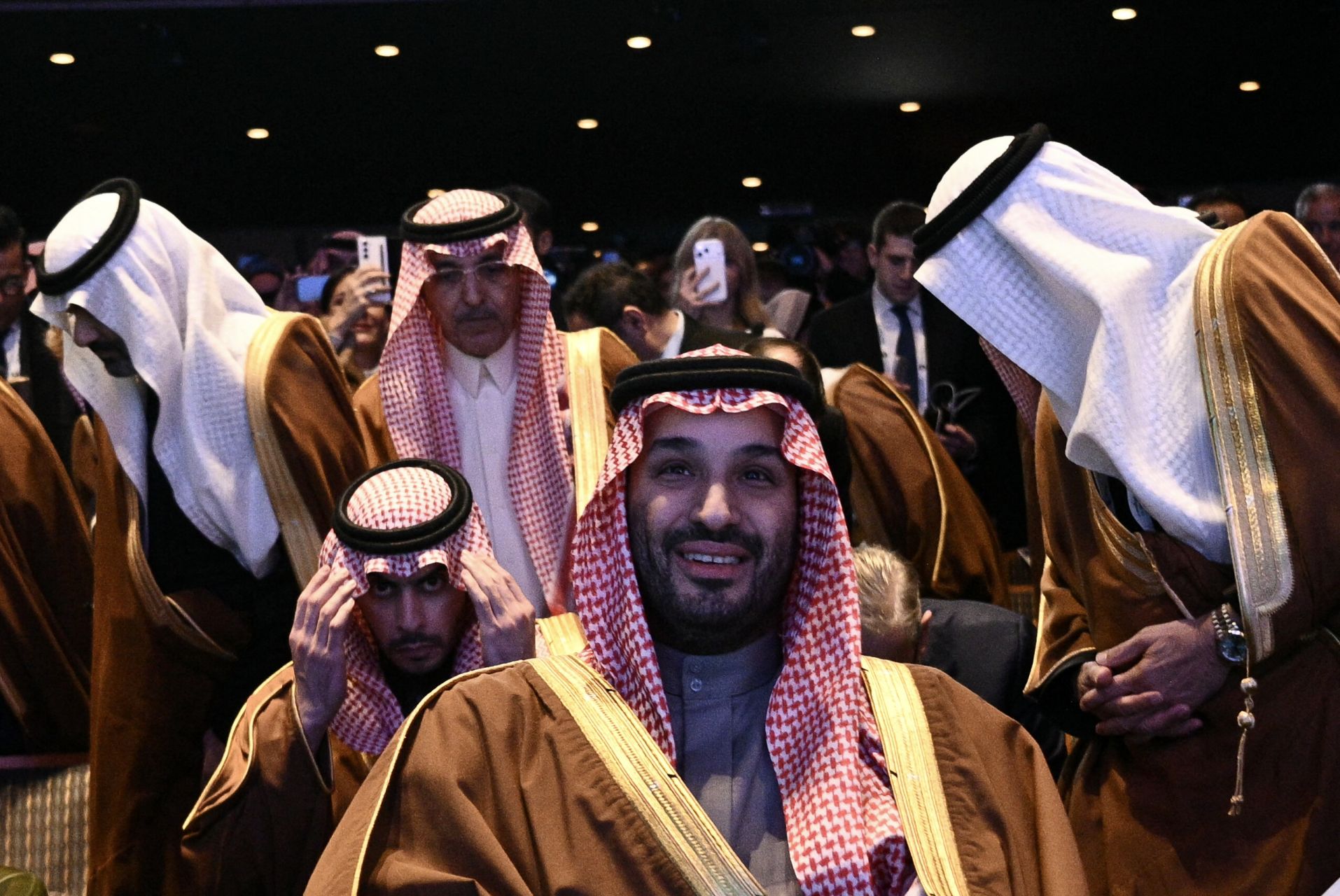
Crown Prince and Prime Minister of the Kingdom of Saudi Arabia Mohammed bin Salman and member of the Saudi Arabia delegation listen as US President Donald Trump speaks during the US-Saudi Investment Forum at the John F. Kennedy Center for the Performing Arts in Washington, DC on November 19, 2025. ©Brendan Smialowski / AFP
Saudi Arabia greenlit its 2026 budget Tuesday, projecting a deficit of 165 billion riyals ($44 billion) as the kingdom presses on with an ambitious spending drive to diversify its oil-dependent economy.
The Arab world's largest economy is overseeing a major push to slash its dependence on oil revenues, with officials pouring billions into projects to attract investment and tourism.
To help meet that goal in the coming year, the ministry said the state's general budget for 2026 would have total expenditures of 1.313 trillion riyals ($350.1 billion) and total revenues of 1.147 trillion riyals ($305.8 billion).
The projected deficit amounts to 3.3 percent of GDP, which is lower than the deficit of 245 billion riyals estimated for 2025, which is equivalent to 5.3 percent of GDP, according to the finance ministry.
The ministry also forecast that the economy would grow by 4.6 percent in 2026.
In September, Saudi Arabia predicted its deficit in 2025 would more than double previous estimates due to falling oil revenues and higher-than-expected spending.
Ahead of the budget's official approval, the kingdom's finance minister, Mohammed al-Jadaan, defended the government's latest fiscal plan.
"The current level of deficit is a policy choice," the minister said at a briefing before the budget's publication.
"We need to invest in our economy and so long as the return from these investments is higher than the cost of the debt, we will continue that drive."
Futuristic New City
The budget figures will be keenly watched by energy industry experts, with the hopes of gleaning insights into where Saudi Arabia expects oil revenues to head in the near future.
The kingdom's revenues are still heavily dependent on its petroleum exports.
Continued global economic uncertainty and a glut in supply has weighed on the market throughout most of the year, prompting lower crude prices.
Crude oil prices have hovered in the $60 to $70 per-barrel range in the US and international markets, down by about $10 from the 2024 period.
Geopolitical issues, including US sanctions targeting Russian energy companies in October, have helped keep prices from sliding further.
"The Saudis will want to strike a balance between sending strong but realistic spending signals. The oil price environment will loom heavily over this crucial balancing act," said Robert Mogielnicki of the Arab Gulf States Institute in Washington.
Saudi Crown Prince Mohammed bin Salman is overseeing the kingdom's Vision 2030 plan that has seen billions spent on entertainment, tourism, sports and even artificial intelligence in a bid to expand Saudi Arabia's economy.
Among the Saudi "gigaprojects" is NEOM, a futuristic $500 billion new city that has reportedly been beset by myriad problems.
AFP
Read more
Comments