- Home
- Highlights
- Pope Leo’s Speech During Youth Meeting in Bkerke
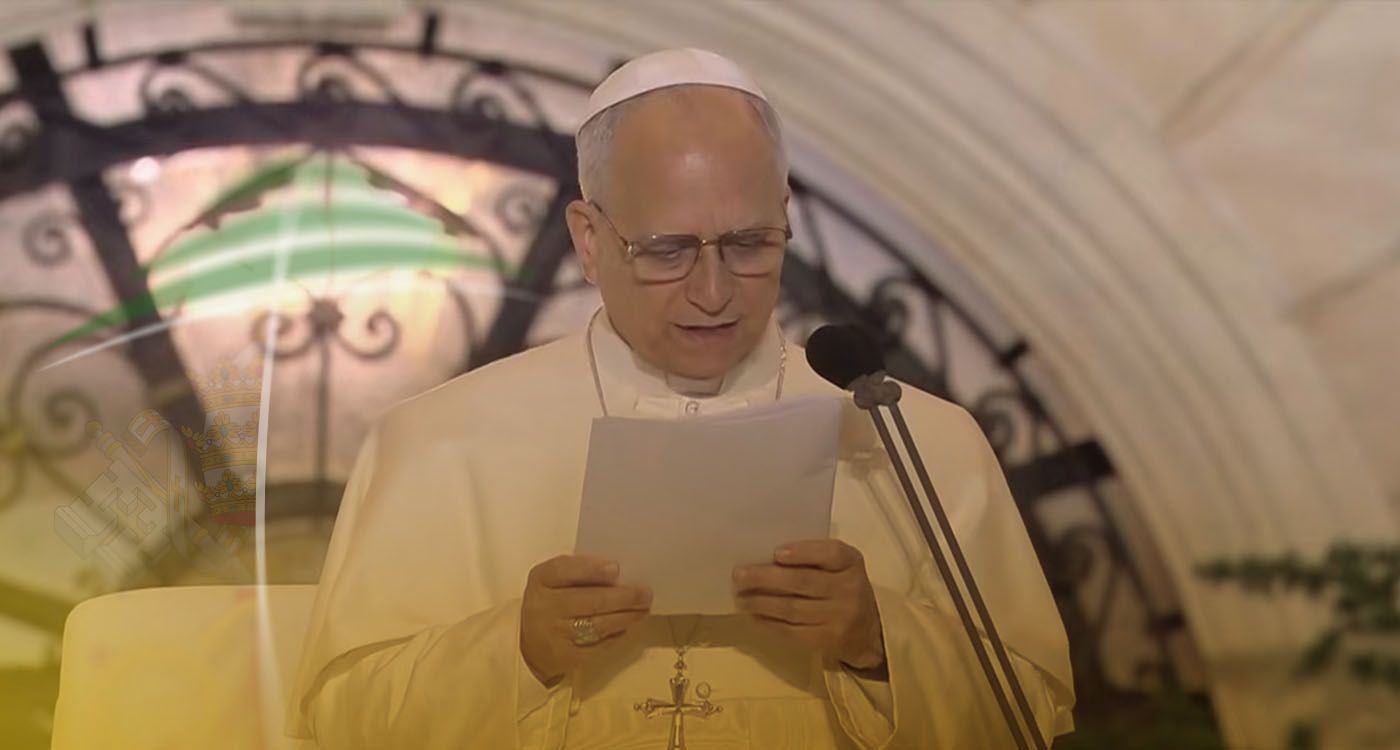
Pope Leo XIV delivered a speech on Monday evening in Bkerke, during the youth meeting, one of the key stops of his three-day visit in Lebanon.
Dear young people of Lebanon, “assalamu lakum!” (peace be with you!)
This greeting of the Risen Jesus (cf. Jn 20:19) sustains the joy of our meeting. The enthusiasm we feel in our hearts expresses God’s loving closeness, which brings us together as brothers and sisters to share our faith in him and our communion with one another. I thank all of you for your warm reception, as well as His Beatitude for his cordial words of welcome. I extend a special greeting to the young people from Syria and Iraq and to the Lebanese who have returned home from abroad.
We, myself included, are gathered here to listen to one another, and to ask the Lord to inspire our future decisions. In this regard, the testimonies that Anthony, Maria, Elie and Joelle have shared with us truly open our hearts and minds. Their stories speak of courage in the midst of suffering, hope in the face of disappointment, and inner peace during times of war. They are like shining stars in the night sky, offering us a glimpse of the first rays of dawn. In all these conflicts, many of us can recognize our own experiences, both good and bad. Lebanon’s history is interwoven with glorious moments, but it is also marked by deep wounds that are slow to heal. These wounds have causes that transcend national borders and are intertwined with very complex social and political dynamics.
Dear young people, perhaps you regret inheriting a world torn apart by wars and disfigured by social injustice. Yet there is hope within you, a gift that we adults seem to have lost. You have time! You have more time to dream, to plan and to do good. You are the present, and the future is already taking shape in your hands! You have the enthusiasm to change the course of history! The true opposition to evil is not evil, but love, a love capable of healing one’s own wounds while also caring for the wounds of others. Anthony and Maria’s dedication to those in need, Elie’s perseverance, and Joelle’s generosity are prophecies of a new future that will be ushered in through reconciliation and mutual help. Jesus’ words are thus fulfilled: “Blessed are the meek, for they will inherit the earth,” and “Blessed are the peacemakers, for they will be called children of God” (Mt 5:5, 9).
Dear young people, live in the light of the Gospel, and you will be blessed in the eyes of the Lord! Your homeland, Lebanon, will flourish once again, beautiful and vigorous like the cedar, a symbol of the people’s unity and fruitfulness. We know well that the strength of the cedar lies in its roots, which are usually the same size as its branches. The number and strength of the branches correspond to the number and strength of its roots. In the same way, the many good things we see in Lebanese society today are the result of the humble, hidden and honest work of so many people of good will, of the many good roots, who do not wish to make merely one branch of the Lebanese cedar grow, but the entire tree, in all its beauty. Draw from the good roots of those dedicated to serving society without using it for their own interests. With a generous commitment to justice, plan together for a future of peace and development. Be the source of hope that the country is waiting for! In this regard, your questions allow us to chart a course of action that is certainly challenging, but also exciting. You asked me where to find a firm foundation for persevering in the commitment to peace.
Dear friends, this firm foundation cannot be just an idea, contract or moral principle. The true principle of new life is the hope that comes from above: it is Christ himself! He died and rose again for the salvation of all. He, the Living One, is the foundation of our trust; he is the witness of the mercy that redeems the world from every evil. As Saint Augustine recalled, evoking the Apostle Paul, “In him is our peace, and from him we draw our peace” (Commentary on the Gospel of John, LXXVII, 3). Peace is not authentic if it is the product of partisan interests. It is only genuinely sincere when I do to others what I would like them to do to me (cf. Mt 7:12). Truly inspired, Saint John Paul II once said that there is “no peace without justice, no justice without forgiveness” (Message for the 35th World Day of Peace, 1 January 2002). This is indeed true: forgiveness leads to justice, which is the foundation of peace. Your second question can also be answered in precisely the same way. It is true that we live in an era when personal relationships are fragile and consumed as if they were objects. Even among the young, personal interests can sometimes take precedence over trust in others, and caring for others is replaced by one’s own gain. Such attitudes turn even beautiful realities like friendship and love into something superficial, confusing them with a sense of selfish satisfaction. If our ego is at the center of a friendship or loving relationship, it cannot bear fruit. Similarly, it is not true love if we only love temporarily, as long as the feeling lasts: if love has a time limit, it is not truly love. Conversely, friendship is genuine when it places “you” before “I.”
This respectful and welcoming way of looking at others makes it possible for us to build a greater “we,” open to society as a whole and to all of humanity. Love is authentic and can last forever only when it reflects the eternal splendor of God, who is love (cf. 1 Jn 4:8). Solid and fruitful relationships are built together on mutual trust, on this “forever” that is the beating heart of every vocation to family life and religious consecration. Dear young people, what expresses God’s presence in the world more than anything else? Love, charity! Charity speaks a universal language, because it speaks to every heart. It is not just a concept, but a story revealed in the lives of Jesus and the saints, who accompany us in life’s trials. Consider the many young people who, like you, have not allowed themselves to be discouraged by injustices and negative examples, even those found within the Church. Instead, they have tried to forge new paths in search of the Kingdom of God and its justice. Drawing on the strength you receive from Christ, build a better world than the one you inherited! As young people, you form relationships with others more easily, even those from different cultural and religious backgrounds. The true renewal that a young heart desires begins with everyday gestures: welcoming those near and far, offering a hand to friends and refugees and forgiving enemies — a difficult but necessary task. Let us look to the many wonderful examples set by the saints! Consider Pier Giorgio Frassati and Carlo Acutis, two young people who were canonized in this Jubilee Year.
Consider the many Lebanese saints. What singular beauty we see in the life of Saint Rafqa, as she endured years of suffering from illness with strength and gentleness! How many acts of compassion performed by Blessed Yakub El-Haddad as he helped those abandoned and forgotten by everyone! What powerful light comes from the darkness into which Saint Charbel chose to withdraw, later becoming one of Lebanon’s symbols throughout the world. His eyes are always depicted as closed, as if veiling an infinitely greater mystery. Through the eyes of Saint Charbel, which were closed in order to see God more clearly, we continue to perceive God’s light with greater clarity. The song dedicated to him is beautiful: “O you who sleep, and whose eyes are light for ours, on your eyelids a grain of incense has blossomed.” Dear young people, may the divine light also shine on your eyes and may the incense of prayer blossom forth. In a world of distractions and vanity, take time each day to close your eyes and look only at God. He sometimes seems silent or absent but reveals himself to those who seek him in silence.
As you strive to do good, I ask you to be contemplatives like Saint Charbel by praying, reading Sacred Scripture, participating in Holy Mass, and spending time in adoration. Pope Benedict XVI said to the Christians of the Levant, “I encourage you to cultivate a true and lasting friendship with Jesus through the power of prayer” (Post-Synodal Apostolic Exhortation Ecclesia in Medio Oriente, 63). Dear friends, Mary, the Mother of God and our Mother, shines forth among all the saints as the Most Holy. Many young people carry a rosary with them at all times, either in their pocket, on their wrist or around their neck. How beautiful it is to look at Jesus through the eyes of Mary’s heart! Even from here, where we are right now, how sweet it is to lift our gaze to Our Lady of Lebanon with hope and trust! Dear young people, I would like to leave you with a simple and beautiful prayer attributed to Saint Francis of Assisi: “Lord, make me an instrument of your peace: where there is hatred, let me sow love; where there is injury, pardon; where there is discord, unity; where there is doubt, faith; where there is error, truth; where there is despair, hope; where there is sadness, joy; where there is darkness, light.” May this prayer keep the joy of the Gospel and Christian enthusiasm alive in your hearts. “Enthusiasm” means “having God in your soul.” When the Lord dwells in us, the hope he gives us bears fruit in the world. In fact, hope is a “poor” virtue, because it presents itself empty-handed: its hands are always free to open doors that seem to be closed due to fatigue, pain or disappointment.
The Lord will always be with you, and you can be assured of the support of the whole Church in the decisive challenges in your lives and in the history of your beloved country. I entrust you to the protection of the Mother of God, Our Lady, who from the summit of this mountain looks upon this new blossoming. Young people of Lebanon, grow strong like the cedars and make the world blossom with hope!
Read more
Comments