- 25
- Nov.
- 2025

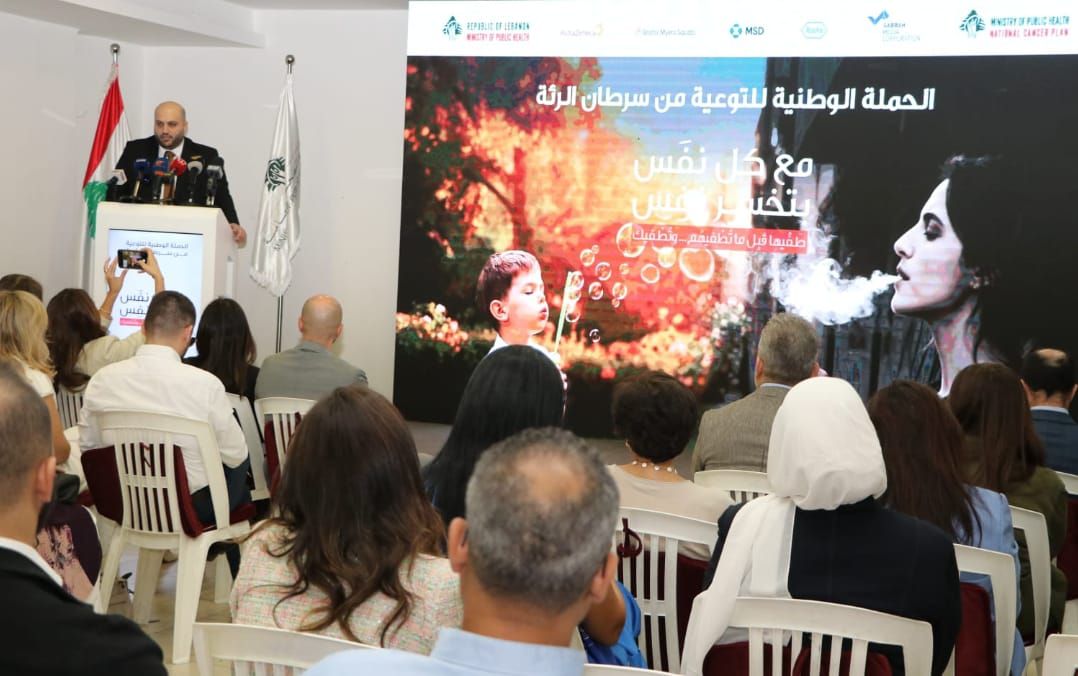
At the Ministry of Health, a few days ago, the air was (for once) smoke-free. But in every speech, in every figure, one could hear very loudly what the sidewalks of Beirut repeat in silence: in a country that ranks third worldwide for cigarette consumption, the real emergency is no longer to vote for laws, but to apply them.
The conference room of the Ministry of Public Health filled up early in the morning. Blue and white banners, printed slogans, serious faces. Under the slogan “With Every Breath… You Lose a Breath” – “With each breath, you lose a breath” – the ministry, in partnership with the National Committee for the Fight Against Cancer, launched a national awareness campaign on lung cancer. Around the table: Minister of Health Rakan Nassereddine, Dr. Arafat Tfayli, responsible for monitoring the National Cancer Plan, Mrs. Lama Al-Sabbah representing the production company Sabbah Brothers, and, at the center of all emotions, a young widow, Gaelle Kibranian, who told the story of how cigarettes stole her husband.
From the outset, the tone was set: no half-measures. The heart of the campaign constitutes tobacco in all its forms – regular cigarettes, electronic cigarettes, narguileh, passive smoke – and the figure that all experts repeat: more than 80% of lung cancers in the world are linked to smoking. The stated objective is clear: to alert and push for smoking cessation, to reduce exposure to second-hand smoke, and to emphasize that public health is not a luxury, but a right.
The Minister Faces Law 174
In his speech, Rakan Nassereddine hammered home the urgency of “multiplying awareness efforts, especially among young people and very young people.” Family, school, media: everyone is summoned to do their part in the face of what he described as “a growing scourge.” The minister also relayed the most important words relating to tobacco in Lebanon: Law 174.
This law, supposed to strictly regulate tobacco consumption and to prohibit smoking in closed public places, remains, thirteen years later, one of the most openly flouted texts in the country. But smoky cafés, narguilehs on the sidewalks, and cigarettes in restaurants, bars, and administrations are still everpresent. On paper, Lebanon has a respectable law; in reality, the smoke is winning.
“It is necessary to strengthen the implementation of the law on tobacco and to respect the ban on smoking in public places,” the minister insisted. Ici Beyrouth can only share this observation, while asking the question that thousands of citizens ask themselves: what is the point of invoking Law 174 at the podium if the first cafeteria at the bottom of the ministry is still serving narguilehs at all hours? In Lebanon, there is no shortage of laws, campaigns or press conferences; there is above all a lack of political will to enforce what already exists.
Lung Cancer: Public Enemy Number One
Beyond the Lebanese context, the global figures recalled during the conference are dizzying. Each year more than 2.2 million new cases of lung cancer are diagnosed globally, resulting in 1.8 million deaths annually. Often diagnosed late, lung cancer remains one of the deadliest types. Patients’ stories are almost always the same: years of smoking and symptoms taken seriously too late.
In Lebanon, health indicators show a worrying increase in cases of lung cancer. The correlation is obvious: the explosion in the consumption of tobacco in all its forms, trivialization of narguileh among adolescents, and the omnipresence of smoke in public spaces. Another shocking figure recalled during the meeting: Lebanon ranks third in the world for cigarette consumption. A bronze medal the country could well have done without.
The economic cost must also be considered; tobacco represents nearly 1.9% of the annual GDP. At the scale of a bloodless economy, this means billions of pounds are wasted on hospitalizations, treatments, and work stoppages. But most importantly: the human cost. It is impossible to quantify the number of shattered lives from this industry.
The Ministry’s Strategy: From School to the Primary Health Center
Dr. Arafat Tfayli, who is piloting the implementation of the National Cancer Plan, detailed the current lines of work. First, an education program in schools to explain the dangers of tobacco to the youth. In a country where middle school students share a narguileh as they would share a fruit juice, talking early about risk, dependence, and cancer is no longer a pedagogical luxury, but a public health measure.
Next, the ministry wants to improve lung cancer screening tests among heavy smokers to identify the patients at high risk. The ministry also seeks to strengthen coordination with primary health care centers throughout the territory so that anti-tobacco messages, cessation advice, and referral to screening services do not remain confined to university hospitals in Beirut.
Dr. Tfayli also mentioned the creation of an anti-smoking body or federation responsible for structuring efforts, involving learned societies, NGOs, the media and, ideally, municipalities. Because without tangible efforts, no national strategy can withstand the weight of social habits and economic interests.
Art, Media… and the Lebanese Reality
On behalf of the Sabbah Brothers, Mrs. Lama Al-Sabbah recalled the role of the media and the audiovisual industry: “The screen does not only serve to transmit the news, it can be a bridge between official initiatives and the general public.” In clear terms: when soap operas, series, or talk shows normalize the cigarette as an accessory of style, they also have the power to desacralize it, even to make it look outdated.
Lebanon lives in a permanent contradiction: anti-smoking spots on one side and photos of smoky evenings and influencers with a pack in hand on the other. Without an assumed cultural shift, the best campaign will remain background noise in a society where “smoking is normal,” and where asking someone to put out a cigarette in a café still sometimes earns you amused or even hostile looks.
The Human Face of the Epidemic
The strongest moment of the ceremony came when Gaelle Kibranian took the floor. No slides, no statistics, just a trembling voice and a story that we have already heard too often, but never in this way.
She spoke of her husband, who died of lung cancer, and their daughter, now seven years old, who is growing up without a father. She told of the attempts to quit, the relapses, the pack “that you never really let go of,” the evenings when you tell yourself that “it’s only one more cigarette.” Then the announcement of the diagnosis, the treatments, hope that dwindles and, in the end, an empty armchair at home.
In her testimony, Gaelle pointed to two clearly identified culprits: personal dependence on tobacco, of course, but also “the absence of national control” and the perception of tobacco as “a normal part of life.” As long as smoking remains perceived as a banal social reflex and not as a high-risk behavior, new families will join, year after year, the procession of the bereaved.
What This Campaign Says – And Does Not Say
This campaign has an undeniable merit: it reminds us, with figures to back it up, that tobacco is not a Mediterranean fatality but a massive, avoidable risk factor that ruins lives and public finances. The right levers need to be mobilized to improve this issue: primary care education, screening, mobilization of the media, and the need to enforce Law 174.
But it reveals a disturbing truth: in Lebanon, we know perfectly well what needs to be done, we know to what extent tobacco kills, we know how much it costs… and yet, people continue to smoke in cafés, restaurants, and sometimes even in hospitals. We continue to see teenagers passing a narguileh around on the sidewalk without anyone intervening. We continue to treat Law 174 as a vague piece of advice, not as a binding text.
Until citizens are no longer able to light a cigarette in a restaurant, cafés refuse to fill their clients with smoke, and fines are as regular as poster campaigns, this type of conference will continue.
In the meantime, each new anti-tobacco campaign looks like a paradox: “With Every Breath… You Lose a Breath” is displayed on the walls of the ministry, and once the microphones are turned off, the whole country goes back to taking a drag on its cigarette. The real break, the one that will reduce the 2.2 million cases and 1.8 million deaths in the world, will not be played out in slogans or PowerPoints. It will prevail in front of an ashtray when someone decides to crush their last cigarette… and when the Lebanese state finally helps them avoid lighting another one.

Comments