- Home
- Middle East
- Syria and Israel in Direct Talks, Sharaa Says Damascus Ready for ‘New Chapter’ With U.S.
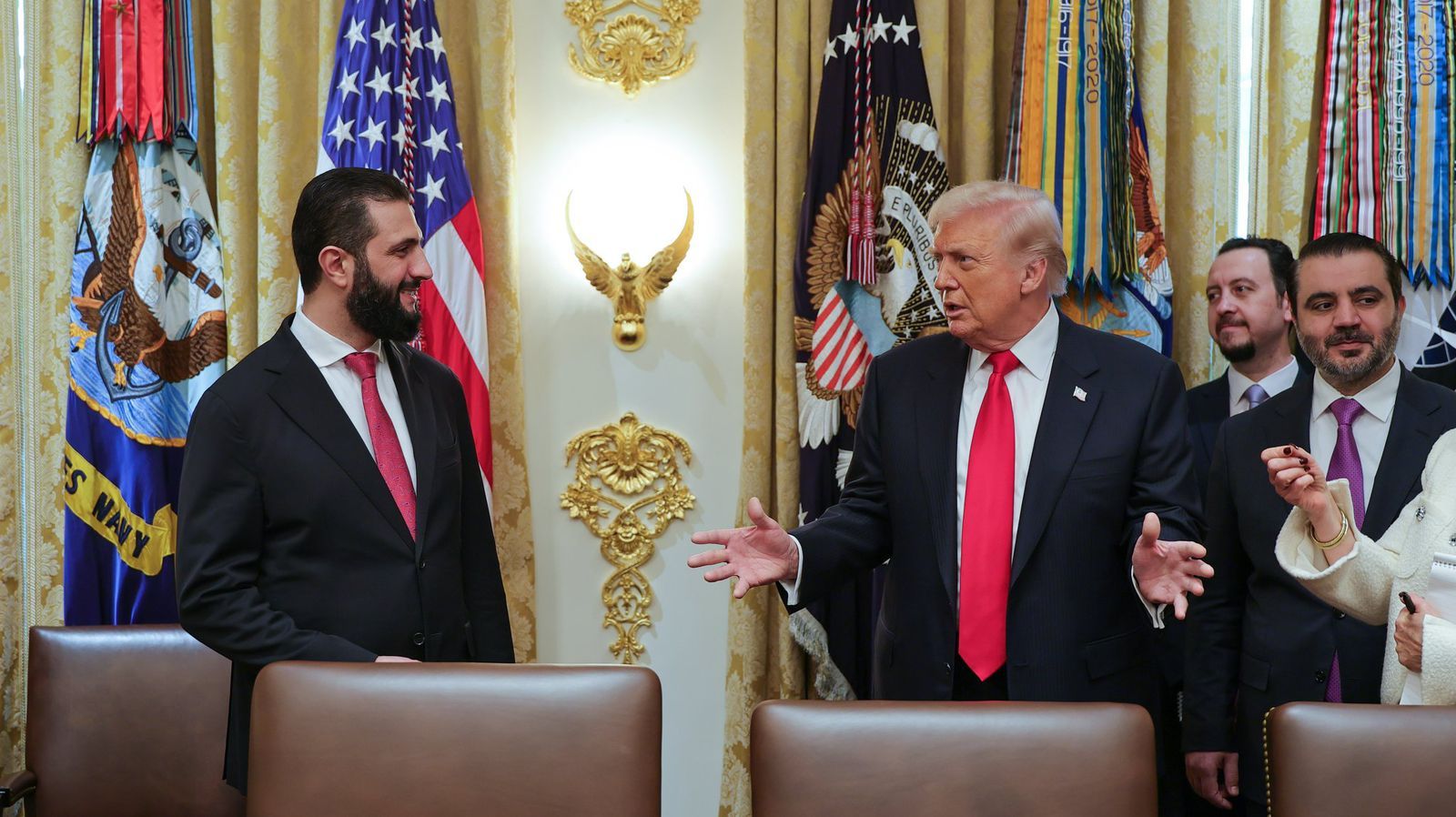
This handout photograph released by This is Beirut on November 10, 2025, shows US President Donald Trump (L) and Syria's President Ahmad al-Sharaa at the White House in Washington DC. ©This is Beirut
Syrian President Ahmad al-Sharaa confirmed that Syria and Israel have begun direct negotiations for the first time in half a century, signaling a major diplomatic shift in the Middle East as Damascus also seeks to rebuild relations with the United States after decades of hostility.
In an interview with The Washington Post after his meeting with U.S. President Donald Trump at the White House on Monday, Sharaa said the talks – facilitated by U.S. mediation and supported by several international actors — are aimed at stabilizing the region and addressing security concerns following years of conflict and political isolation.
Relations With Israel
In one of the most striking revelations of the interview, Sharaa confirmed that Syria and Israel are engaged in direct negotiations for the first time in half a century, with U.S. mediation and support from several international parties, including President Trump.
He accused Israel of breaching the 1974 disengagement agreement that had kept the two countries’ militaries apart for five decades, saying that after the fall of the Assad regime, Israel “revoked the agreement, expanded its presence in Syria, expelled the U.N. peacekeeping mission, and occupied new territory.”
“They have conducted over 1,000 airstrikes in Syria since Dec. 8,” Sharaa said, claiming that Israeli attacks had hit “the Presidential Palace and the Ministry of Defense.”
He argued that Israel’s actions were “not driven by security concerns” but by “expansionist ambitions,” adding that Syria had expelled Iranian militias and Hezbollah fighters from its territory to address Israeli fears.
“We are engaged in direct negotiations with Israel, and we have gone a good distance toward reaching an agreement,” he said. “But to reach a final agreement, Israel should withdraw to their pre–Dec. 8 borders.”
When asked about the possibility of a demilitarized zone south of Damascus, Sharaa rejected the idea:
“This is Syrian territory, and Syria should have the freedom of dealing with their own territory. If a demilitarized zone is used by some parties as a launching pad for hitting Israel, who will be responsible for that?”
He warned that accepting further restrictions on Syrian sovereignty could set a precedent for future Israeli encroachment:
“Israel occupied the Golan Heights in order to protect Israel, and now they are imposing conditions in the south of Syria to protect the Golan Heights. Maybe after a few years, they will occupy the center of Syria to protect the south.”
Push for Sanctions Relief
The Syrian president emphasized in his interview with The Washington Post that national reconstruction and economic stability depend directly on the lifting of Western sanctions, which have strangled much of Syria’s post-war recovery.
“Stability is linked with the economy, and the economy, or economic development, is linked with the lifting of sanctions,” he said.
Sharaa said months of discussions with U.S. officials had yielded “good results,” but that Damascus was still waiting for “the final decision” from Washington. Syrian officials have said that such relief would allow the country to rebuild infrastructure and restore essential services devastated by years of conflict.
Sharaa also said he is seeking to rebuild relations with the United States after a century of fraught ties, declaring that both nations share mutual interests in security, stability, and economic recovery. His remarks come amid cautious talks on sanctions relief and new diplomatic engagement with Washington — including meetings with President Donald Trump and members of Congress.
Sharaa said his trip to the U.S. capital was aimed at “starting on building the relationship between Syria and the United States,” following what he described as “100 years of not a very good relationship.”
“We were looking for common interests between the United States and Syria, and we found that we have a lot of common interests that we can build on,” he told The Post. “The stability of Syria will impact the entire region, and the instability of Syria, as well, will impact the region.”
Defending His Past as a Fighter
Asked how Americans might view a man who once fought against U.S. forces, Sharaa defended his record, saying that combat “for noble objectives” — especially in defense of one’s homeland — should not be condemned.
“Fighting is not something shameful if it’s done for noble objectives, especially if you are defending your own land and the people who are suffering from injustice,” he said. “I have fought so many wars, but I’ve never caused the death of an innocent person.”
He added that the Middle East continues to suffer from “Western and U.S. policies that caused so many wars that were pointless,” noting that “many Americans now agree that some of these policies were a mistake.”
Sectarian Violence and Postwar Rebuilding
Addressing criticism that sectarian divisions persist in Syria, Sharaa said the country is still navigating a fragile transitional phase after six decades of authoritarian rule and more than a decade of civil war.
“Syria just got out of a fierce war,” he said. “We are in the stage of rebuilding the state and restoring and rebuilding the law. But I’m not saying that there are no problems in Syria. It’s not the end of the story.”
He compared the country’s current condition to post–Civil War America, arguing that no nation can achieve stability “one year after a war” and that rebuilding institutions and restoring public trust would take time.
Islamic State and Kurdish Forces
On the continued U.S. military presence in eastern Syria, Sharaa maintained that Syrian forces are capable of handling security independently but suggested a temporary coordination role for U.S. troops in reintegrating Kurdish-led formations, such as the Syrian Democratic Forces (SDF), into the national military structure.
“Keeping Syria divided, or having any military force that is not under control of the government, represents the best environment for ISIS to flourish,” he said.
Sharaa proposed that American troops could “supervise the integration [of the SDF] into the central government’s security forces,” after which “the task of protecting Syrian territory will be the responsibility of the state.”
Balancing Relations With Russia
Sharaa described Syria’s relationship with Russia as “strategic but delicate,” noting that Moscow still shelters former leader Bashar al-Assad and had previously fought against Syrian forces during the conflict.
“We were in war against Russia for 10 years, and it was a hard, difficult war,” he said. “They announced that they killed me several times.”
Despite that history, Sharaa said Damascus values Moscow’s support as a permanent member of the U.N. Security Council.
“We need their vote to be on our side in some issues,” he said. “The issue of Bashar al-Assad is troublesome for Russia… but we will preserve our rights as Syrians to call for bringing Assad to justice.”
On Missing Americans – Austin Tice
Sharaa ended his interview by addressing the longstanding case of American journalist Austin Tice, who disappeared in Syria in 2012. He said his government had established a commission for missing persons that includes foreign nationals and is coordinating directly with U.S. authorities.
“We managed to release an American citizen from the prisons when we got to Damascus and immediately handed him over to American authorities,” Sharaa said.
He added that he had personally met Tice’s mother, who has long campaigned for her son’s return.
“She’s a great woman,” he said. “I also had her meet with my mother, because my mother had a similar story. I went missing for seven years, and everyone thought that I was killed except my mother. She had strong belief that I would come back one day.”
Read more


Comments